October 13, 2026 · RSVP
Wedding No-Shows: A Guide for Planners
At a wedding, a guest no-show is very visible: the empty chair at a table already set, the plate the caterer served that nobody ate, the place on the seating chart left without its guest. For the wedding planner or planning firm handling many weddings a season, this isn’t a one-off surprise. It’s a cost that repeats with every contract and that, in the end, spills over into the relationship with the client and with the partner caterer.
This guide is for people who plan weddings professionally: why wedding no-shows still happen even with a closed list, how much they weigh on a planning business, and a practical routine to shrink the gap between who RSVPed and who showed up.
Why no-shows hurt more with smaller guest lists
Smaller, more intimate weddings are a trend that keeps coming up in the industry, often with a higher spend per guest.
For the planner, the consequence is direct: the smaller the list and the higher the investment per head, the more each absence shows. At a wedding for 400 people, ten empty chairs blend into the room. At a wedding for 80, they’re an entire table, and the client notices.
Where no-shows come from at the weddings you plan
In practice, the guest who doesn’t show up almost never decided to skip it on the day. The most common patterns in a planner’s operation are:
- A verbal “yes”: the guest told the groom they’d come, but it never made it onto the planner’s official list.
- An RSVP that’s too old: they answered two months ago, their plans changed and nobody asked again.
- The list in several places: part of it in the planner’s spreadsheet, part in the family group chat, part in the client’s head. Without a single source of truth, the final count is a guess.
- Undefined plus-ones: the invitation says “and guest”, the guest replies “me and a few more”, and nobody knows if that’s two or five.
- No easy way to cancel: the guest would have declined in advance, but there was no easy channel to do it, so they simply don’t come.
What no-shows cost the planner
The most obvious cost falls on the client: catering, drinks, favors and seats paid per head for people who didn’t come (we break that down in what no-shows really cost). But there’s a cost that stays with the planning company:
- Rework on the seating chart, redone several times in the last week as RSVPs change.
- Friction with the partner caterer, who received a final count that didn’t match the room.
- Staff sized wrong (reception, servers, valets) for guests who never came.
- Client perception: an empty table in the photos is remembered as a planning failure, even when the guest was to blame.
A planner’s routine to reduce wedding no-shows
1. One official list, with an owner
Agree with the client, right in the contract, that only what’s on the planner’s list counts. An RSVP given to the groom in the office hallway has to go through the same channel every other guest uses. A host page helps here: the couple can add guests and follow replies themselves, inside the same list, instead of keeping a parallel one.
2. An RSVP deadline aligned with the caterer’s count
Set the cutoff working backward from the day the caterer needs the final number. For weddings with a per-head menu, 3 to 4 weeks before usually works. We walk through the math by event size in how to set the RSVP deadline for each event.
3. A one-tap RSVP, with no app and no account
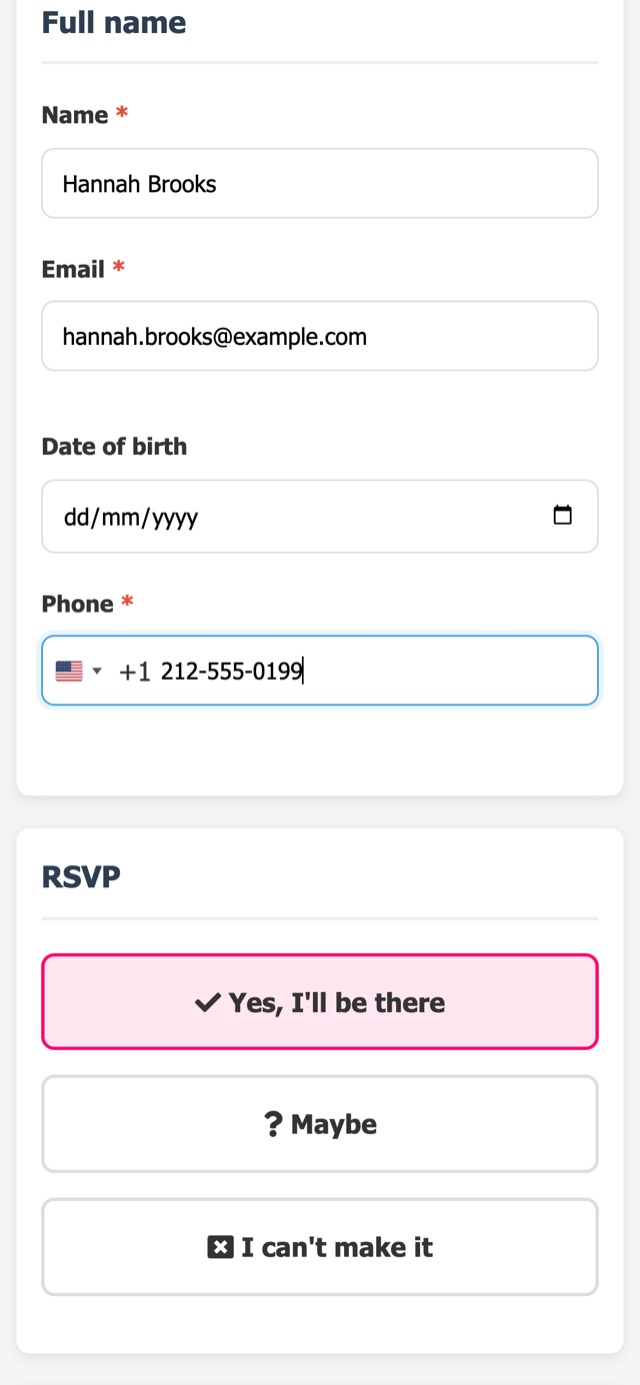
Send the invitation by email with one-tap buttons (Going / Not going / Maybe) that open the wedding’s RSVP page, and give the couple the same link to share in their own messages or print as a QR code on the paper invitation. Guests answer in seconds, with no app to download and no account to create. The less friction, the more people reply, and above all, the more people reply “not going”, which is the most valuable information for preventing no-shows. For guests flying in from abroad, the invitation can also go out on WhatsApp (see RSVPs for destination weddings).
4. Plus-ones defined guest by guest
Instead of “guest + family”, the planner sets how many plus-ones each guest can confirm: the uncle can bring up to 3, the coworker only 1. In RSVPito this is done with the plus-one limit per guest: guests can only confirm within the agreed number, and the count that reaches the caterer stops having surprises.
5. Automatic reminders and a final reconfirmation
Guests who haven’t answered get a reminder before the deadline, sent automatically by email (see automatic RSVP reminders). And close to the wedding, a short reconfirmation for those who said “yes” long ago is worth it, making it easy to let you know about a cancellation. A cancellation announced a week ahead is a seat the client can still reuse.
6. A final count based on history, not guesswork
Track, wedding by wedding, how many confirmed guests actually attended. QR code check-in gives you that number automatically. After a few events, the planner has a margin based on their own data to discuss with the client and the caterer, instead of applying an “industry” percentage nobody knows the origin of.
What changes when RSVPs leave the spreadsheet
In peak season, a planner can have several weddings collecting RSVPs at once. Managing that in spreadsheets, email threads and phone calls is what creates the list in several places, the forgotten RSVP and the final count that doesn’t add up. With RSVPito, each event has its own list, its own branded RSVP page, its own reminders and its own plus-one limits, and your team sees in real time who confirmed, who declined and who hasn’t answered yet, across every wedding your company is handling.
Read more: how to reduce no-shows at events, how planners can professionalize RSVP management and RSVPito’s solutions for wedding and event planners.
Talk to us and see how to reduce no-shows at the weddings your company plans, with one-tap RSVPs and a guest list updated in real time.